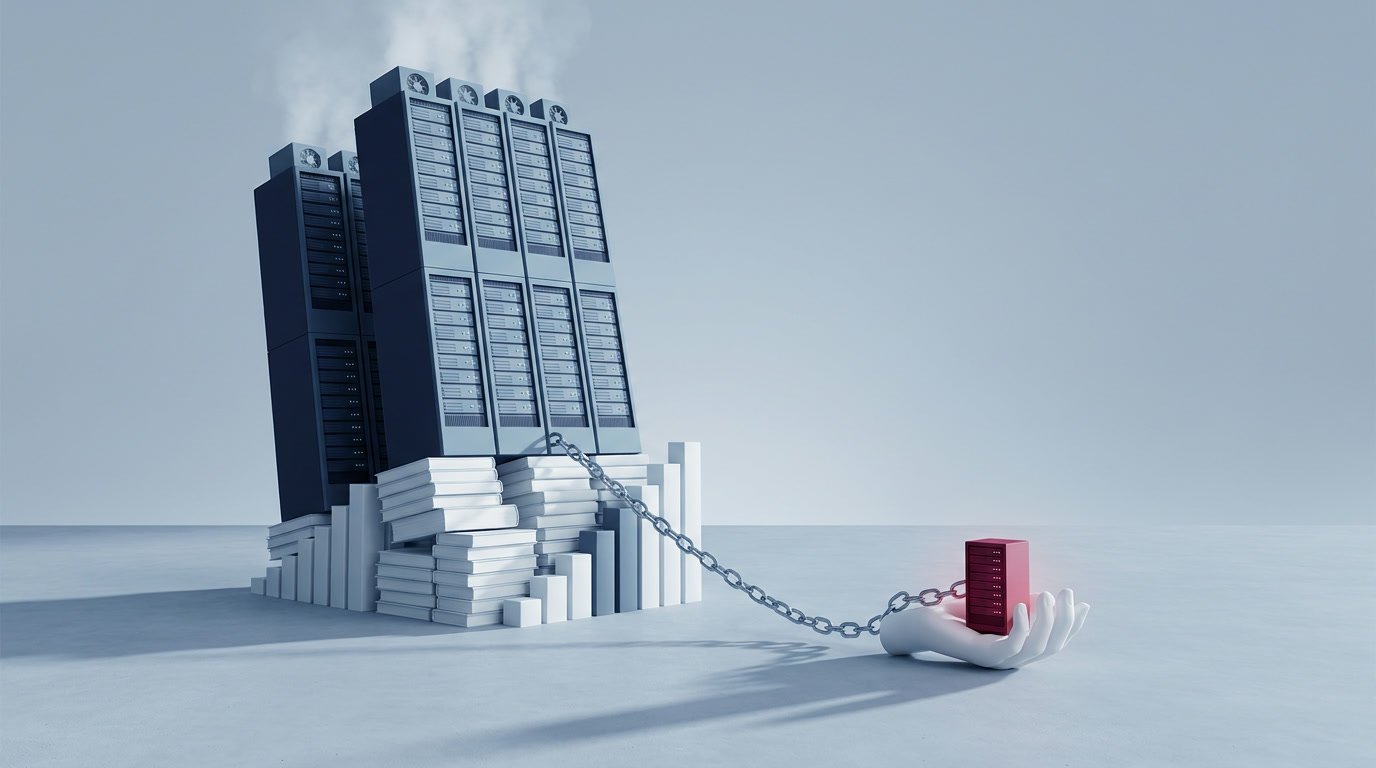
If you own an S&P 500 index fund, you already have money riding on how data center debt plays out — whether or not you ever bought a single AI stock on purpose. The companies building out artificial intelligence are borrowing at a scale the market has rarely seen, and a growing share of that borrowing is structured so it barely shows up on their balance sheets. Here’s what’s actually happening, why credit analysts are nervous, and how it connects to the money in your 401(k).
The numbers behind the AI build-out
The spending is enormous and accelerating. A few figures to anchor the scale, all as of October 2026:
- J.P. Morgan estimates the five largest U.S. hyperscalers will spend $697 billion on capital expenditures in 2026 — up $173 billion since the start of the year.
- Moody’s puts the six largest (Microsoft, Meta, Amazon, Alphabet, Oracle, and Apple) near $700 billion this year, roughly six times their 2022 level.
- S&P expects Amazon, Microsoft, Alphabet, Oracle, Meta, and SpaceX to spend more than $7 trillion on data centers and AI infrastructure between 2025 and 2030 — and to run negative free cash flow until at least 2027.
Companies can’t fund all of that out of pocket, so they borrow. Morgan Stanley estimated in June 2026 that global AI-related debt issuance is on track to hit nearly $570 billion in 2026, more than double the 2025 figure. A large and fast-growing chunk of this is coming from private credit — firms like Blackstone, Apollo, and Ares. The Bank for International Settlements counts more than $200 billion of outstanding private-credit loans to AI-related companies already, and projects that could reach $300 billion to $600 billion by 2030.
The part that’s hard to see: off-balance-sheet debt
This is the detail most casual investors miss, and it’s the one that matters most. A growing share of AI infrastructure debt is being pushed into separate legal entities so it doesn’t appear as debt on the parent company’s balance sheet.
How the Meta-Blue Owl deal works
The template deal closed in October 2025: Meta and Blue Owl Capital financed the $27 billion Hyperion data-center campus in Louisiana — the largest private-credit transaction ever done. The structure is the interesting part. Meta owns just 20% of the joint venture; Blue Owl-managed funds own the other 80%. A special purpose vehicle (SPV) arranged by Morgan Stanley issued $27 billion in A+-rated debt plus $2.5 billion in equity, anchored by PIMCO ($18B) and BlackRock ($3B).
Because Meta is a minority owner of a separate vehicle, the debt doesn’t sit on Meta’s balance sheet the way a corporate bond would. That’s the appeal. The warning sign is in the pricing: despite that investment-grade A+ rating, Morningstar reported the debt yielded 6.58% at issue — a yield you’d normally associate with high-yield (junk) bonds, not A+ credit. Lenders are demanding more than the rating alone would suggest.
Why this clouds the picture for outside investors
The Hyperion model has caught on. Companies have used off-balance-sheet SPVs to move more than $120 billion in data center spending off their balance sheets in roughly eighteen months, and the Meta template has since drawn another $40 billion-plus in similar placements. On top of that, Moody’s counts more than $820 billion in hyperscaler lease commitments for data centers that haven’t even started operating yet — obligations it treats as debt-equivalent liabilities.
The honest problem is visibility. As S&P’s Mark Habib put it, if a deal isn’t reported or rated by his firm, “we might not have the visibility,” adding that it’s “safe to assume that there is more (debt) out there that we are not seeing.” When a credit agency says that out loud, it’s worth taking seriously. The reported debt is not necessarily the whole debt.
Where the stress is showing up right now
Not all AI borrowers are created equal, and the market is starting to separate them. The pressure is concentrated on the lower-rated, more debt-dependent names — not the cash-rich giants.
Oracle carries a Moody’s rating of Baa2 with a negative outlook — just two notches above junk. On October 15, 2026, its five-year credit default swap (CDS) spread widened 26 basis points to a record 288 basis points, up 287% over the prior year. A CDS spread is essentially the cost of insuring against default; when it jumps, it means investors are paying up for protection.
CoreWeave, an AI cloud provider already rated below investment grade, is under heavier strain. Yields on its 9.75% bond due 2031 reached 15.78%, and its five-year CDS spread briefly blew past 1,140 basis points. The stock fell more than 25% in the week of October 12–18, 2026 — its worst week since November 2025. Reuters estimated that CoreWeave, Nebius, Oracle, and Dell shed roughly $80 billion in combined market value in a single day on October 14.
Moody’s has also flagged what it calls a “circular AI ecosystem”: hyperscalers invest in AI labs like OpenAI and Anthropic, which then spend heavily on those same investors’ cloud services. The money loops back, which flatters revenue — but concentrates the risk if AI demand ever slows.
Important: wider spreads are not defaults
Keep this in proportion. None of these companies has defaulted or signaled it might. Wider CDS spreads make insurance more expensive; they do not mean a payment was missed. S&P said in mid-October that it does not currently see a gap between its ratings and the market’s view big enough to force rating changes. And the sell-off was already partly rebounding — the Nasdaq saw “buy the dip” gains on October 18, 2026. Whether this turns out to be a short correction or a lasting repricing was still unresolved as of this writing. Treat any confident crash-or-boom prediction with skepticism.
Why this reaches your 401(k)
Here’s the connection most people don’t make. You don’t need to own CoreWeave or Oracle bonds to be exposed. The “Magnificent 7” — Apple, Microsoft, Nvidia, Alphabet, Amazon, Meta, and Tesla — made up 34.9% of the S&P 500’s market cap as of October 7, 2026, up from 13% in 2018. That’s the highest top-seven concentration since the “Nifty Fifty” era of the early 1970s.
So a standard S&P 500 index fund — the default in millions of retirement accounts — is now more than a third invested in a handful of companies whose AI capex and debt are under active market scrutiny. Index funds feel diversified. On the AI-capex question, they are more of a concentrated bet than most people assume.
The balancing nuance
This is not a doom case. Moody’s has been explicit that Microsoft, Alphabet, Amazon, and Meta hold among the strongest corporate balance sheets in the world, which makes any near-term threat to their investment-grade ratings unlikely. These companies can self-fund enormous spending in a way that Oracle and CoreWeave cannot. The risk is not that the giants default tomorrow; it’s that the market may be underpricing how much of the sector’s growth is debt-financed, how much of that debt is hard to see, and how much of your portfolio sits in a small cluster of the same names.
What I’d actually do with this information
- Know your real exposure. Look up the top-10 holdings of your main index fund. If it’s an S&P 500 or total-market fund, roughly a third is in AI-capex-heavy mega-caps. That’s fine — just know it.
- Don’t confuse “index fund” with “diversified” on this specific risk. If you want less concentration, equal-weight S&P 500 funds and international allocations dilute the top-seven weighting considerably.
- Be cautious with the pure-play, high-yield names. I would not treat a 15%+ bond yield from a below-investment-grade AI cloud provider as free money. That yield exists because the market sees real default risk.
- Follow the credit signals, not just the stock price. CDS spreads and bond yields on names like Oracle and CoreWeave are moving faster and telling you more than the headline share prices.
- Re-check the figures. This story is moving day to day. The numbers here are current as of October 19, 2026, but confirm them before you make a decision on them.
Frequently asked questions
Does data center debt mean the big tech companies are about to collapse?
No evidence points that way. Moody’s rates Microsoft, Alphabet, Amazon, and Meta among the strongest balance sheets globally, and none of the stressed AI names has defaulted or signaled it might. The concern is concentrated on lower-rated, debt-dependent players like Oracle (two notches above junk) and CoreWeave (already below investment grade), plus the fact that a lot of sector debt is structured to be hard to see.
What is off-balance-sheet AI debt, and why does it matter?
Companies route data center financing through separate legal entities (special purpose vehicles), often owning only a minority stake, so the debt doesn’t appear on their own balance sheet. Meta’s $27 billion Hyperion deal — where it owns just 20% — is the template. More than $120 billion has moved off balance sheets this way in about eighteen months. It matters because outside investors, and even rating agencies, can’t fully see the true debt load. S&P has openly said there’s likely “more out there that we are not seeing.”
Is my S&P 500 index fund exposed to this?
Yes, indirectly. As of early October 2026, the seven largest companies made up about 34.9% of the S&P 500 — the highest concentration since the 1970s — and several of them are the biggest AI spenders. You won’t typically own the risky high-yield AI bonds directly, but your index fund is a meaningful bet on the mega-caps driving the AI capex boom.
Should I sell AI-related investments because of the October 2026 sell-off?
This article can’t give you personal advice, and the honest answer is that nobody yet knows whether the mid-October 2026 drop was a short correction or a lasting repricing — markets were still swinging daily and had partly rebounded by October 18. Rather than react to one week of moves, the practical step is to understand your actual concentration, decide whether it matches your risk tolerance, and avoid chasing double-digit bond yields from below-investment-grade AI borrowers without understanding why those yields are so high.